People are increasingly socially isolated, jobless, and lacking fulfillment in their lives. AI is a constant fear, TikTok and Reels are gobbling attention spans, relationships are on the decline, prices are going up, and more.
If the couple sentences above are ones that you see in the news and media all the time you're not alone. I get the general sentiment from many of my newly college-graduated peers that things are going downhill. There is a longing for a time before technology took over our lives and a return to simpler times.
Why are we trying to make the future look like the past? Why aren’t we focusing on making the future better? I do not ask this rhetorically. I have a theory on why we want our perceived version of the past back. This may or may not be evidence backed. I just wrote it down based on anecdotal experience.
It makes sense that someone would want to go back because some things are worse! Humans want to protect themselves at an instinctual level. If we can make the worst things better by going into the past, then it makes sense why one might want to return there. Many of my peers refer to a time in the late 20th, early 21st century, which while not free of strife, is perceived as a relatively stable period of time. There was technology but not too much that it interfered in our lives. Wages were closer in line with prices. We like the idea of the safety of that time. Paired with the instability we glean from the algorithms, we want to go back.
The problem with this outlook is that our view on the change between now and the past is distorted. Good changes between times of the past and present are not remembered. We forget how a thing was bad in the past relative to the state of the thing in the present and instead take the good thing for granted. For example, the below graph shows child mortality rates. This is a graph we should all be extremely, extremely proud of.
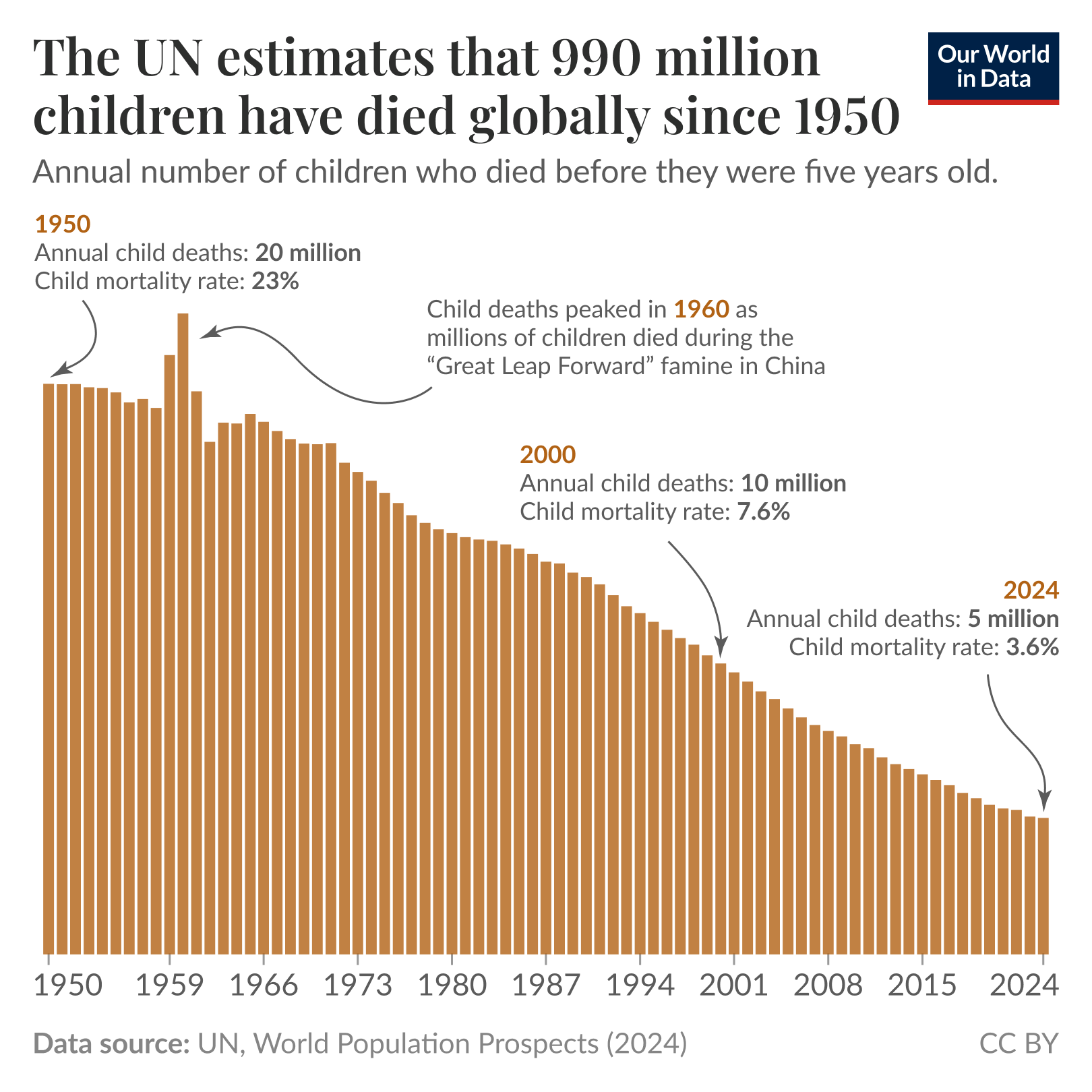
Seventy five years ago, the child mortality rate was 23%!! Almost a fourth of children died before the age of five. While it was still a tragedy then, it was also just a part of life. Now, a regular child dying before the age of five would be seen as a terrible unheard of accident. Our scale for catastrophe has become more sensitive. As we advance in certain ways, we distort the lens for how we measure mad things in our life. It has become more sensitive. We yearn for the past, but only the good parts. We don't remember the bad.
This brings me to my next point. We don't see the lack of catastrophe because it is invisible. We do not think of the five year old child still being alive as a great triumph of medical science. We just think of them as an ordinary regular child. We don't think about the mitigation of hundreds of thousands of deaths from advanced medicine because those deaths never happen. We treat the good thing as the new norm. It is now a neutral thing to us. The present is just neutral in some ways or bad in others.
I am tired of hearing how things have gotten worse and how we should go back to prior times of perceived splendor. Why not dream and invent a better future instead? Obviously this kind of dreaming and imagination is hard and challenging, but the safer option of just going back in time seems a bit trite. If there is any attitude we should take from the past it is the dream of a better future. That is why the child mortality graph looks the way it does. Billions of people work towards making the future better, not returning to the past. There is no biological rule preventing us from making tomorrow better than today. What if we can make the future better than our present, past, and perceived past?